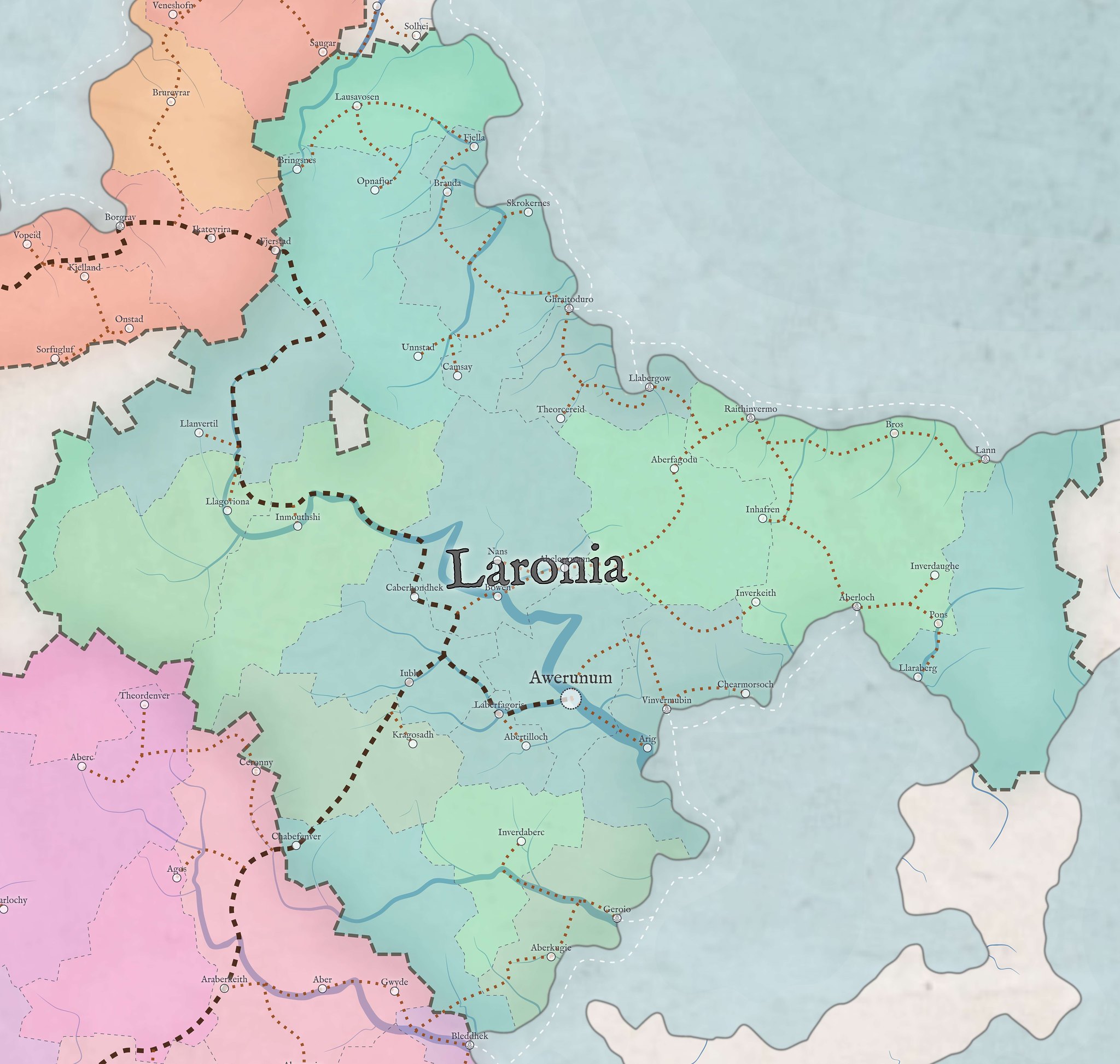
Laronia
Orradûn
State on the Southeastern coast of the Eastern Continent of Craia.
Most Druids in this region are Circle of the Moon, but they do not have significant power within the government.
Several large trading cities along the coast, merchant guilds are very influential.
## ROUGH FRAMEWORK BELOW - IN PROGRESS
Government of Laronia: The Council of the Voice
Foundational Philosophy:
“No one speaks for the land, but all must speak from it.”
The Laronian government is a representative democracy guided by consensus-seeking councils rather than hierarchical rulers. It is rooted in cooperation, transparency, and communal stewardship, making it highly compatible with the ethos of the Circles—but more structured and law-oriented.
Structure Overview
The Council of the Voice (National Assembly)
Primary legislative body of Laronia
Composed of elected delegates from each village, city, or independent region
Each delegate is called a Voice, symbolizing that they carry the words of their community, not their own
Meets in [PLACE] at the Forum of [TBD], a massive open amphitheater built around a grove of ancient whitebark trees
Responsibilities:
Passes legislation and public policy
Oversees diplomacy (including relations with Circles and the Koalitio)
Sets trade laws, civil rights, land use, and magical safety standards
Creates commissions for resolving inter-regional disputes
The Triad of Balance (Executive Trio)
A three-person leadership body elected by the Council every ten years, each representing a guiding pillar of Laronian society:
The Arbiter of Land – Oversees environmental and agricultural policy, ensuring harmony with nature (typically someone who collaborates with the Circle of the Land)
The Speaker of the People – Responsible for civil welfare, education, and infrastructure; often from urban or trade backgrounds
The Warden of Exchange – Manages trade, finance, diplomacy, and outer relations (often most in contact with Circle representatives and foreign dignitaries)
These three must agree by majority to enact any executive decision. If they cannot, the Council resolves by vote.
The Regional Forums (Local Governance)
Each settlement governs itself through a Forum, an elected local council typically composed of:
1 Voice (representative to the national Council)
3–7 Forum Elders (elected by the town, sometimes referred to as “Rootholders”)
1 Civic Steward, often a rotating position, handles day-to-day operations
Regional Forums may develop their own traditions (some more Circle-aligned, others more secular or trade-focused), but they must uphold the Concord of Earth and Sky — a foundational agreement to protect nature, uphold civil rights, and engage peacefully.
Advisory Roots: The Grove Liaisons
To maintain harmony with druidic cultures, Laronia employs Grove Liaisons—voluntary representatives from:
Circle of the Moon
Circle of the Land
Occasionally the Circle of Shepherds or Circle of Stars
These liaisons do not vote, but they offer spiritual counsel, environmental warnings, and serve as cultural bridges during Council meetings or public disputes. Their presence is seen as a gesture of respect and balance, not governance.
The Guard of the Voice (Peacekeeping and Defense)
A non-militarized, decentralized peacekeeping force
Sworn to protect citizen rights, natural sites, and free movement
Organized into regional “Watches” trained in de-escalation, diplomacy, and emergency aid
In rare times of major danger (e.g. the rise of The Return), the Council may appoint a Temporary Shield to coordinate defense efforts with druidic Groves
Compatibility with the Circles
Circle of the Moon: Respects Laronia’s ritual integration, use of non-hierarchical leadership, and animal stewardship laws
Circle of the Land: Aligns with decentralized forums, land-use limitations, and the Triad’s emphasis on natural harmony
Druidic Pilgrims: Often welcomed to speak at forums or offer seasonal guidance, though they do not vote unless they are citizens
Laronia, as the independent and democratic region of Craia, reflects the diversity of choice—a place for those who value autonomy, self-governance, or a life apart from the Druidic Circles. While much of Craia is Druid-centric and Elven in origin, Laronia’s population is broader and more balanced, both ethnically and culturally.
🌍 Laronia’s Population
Elves remain the most numerous and influential ancestry in Laronia, especially due to:
Their ancient roots in the region (many settlements predate Laronian independence)
A cultural pull toward long-term stewardship, arts, and civic philosophy
Some formerly affiliated with Circles (especially Land or Moon) who opted for a different way of life
Subtypes found in Laronia:
Wood Elves – Common in forest-border towns and rural villages
High Elves – Often lead in academia, medicine, diplomacy
Eladrin & Other Seasonal Kin – Rarer, but occasionally part of traveling communities
Humans make up a strong portion of the working population. Many are:
Descended from those who left Circle lands generations ago
Traders, farmers, scholars, or craftspeople
Politically active and heavily represented in the Council of the Voice
Laronian humans are known for their cultural adaptability, and many integrate elven customs, languages, or architecture into their local traditions.
Gnomes thrive in river settlements and artisan quarters (especially in [PLACE])
Dwarves are common in [PLACE] and other cliffside settlements
Halflings form tightly knit communities, especially in fertile areas like [PLACE]
Dragonborn are rarer but respected—often found in the port city of Flowgate, many working in diplomacy or security
🧚 Half-Elves, Tieflings, Aasimar, & Others – ~10%
Half-elves are especially common in political roles or as cultural liaisons
Tieflings??? may find more belonging here than in traditional Druidic cultures
Aasimar??? are rare, but often viewed with mystical reverence, particularly by spiritual communities
Cultural and Class Makeup
Laronia has a smaller percentage of druids than the Circles but still more than most places in the world.
Most are ex-Circle, self-taught, or grove-independent
Some are spiritual advisors, land stewards, or teachers. Others use druidic magic to enhance trade, healing, or civic services.
A handful live more like hermits, choosing the wilds of Laronia’s untouched borderlands
Fighters & Rangers: Especially common in the Guard of the Voice, hunters, and caravan scouts
Bards: Found in every major city and forum, often act as speakers, historians, or cultural emissaries
Artificers & Wizards????: Primarily based in Starhold, where magical research is more structured than in the Circles
Clerics & Paladins: Present, though more rare – most frequently affiliated with the Wild Mother or Moon Goddess, but some other deities are also observed here more than in the Druid Circles.
Rogues & Monks: Found in specialized roles—spies, scouts, political agents, or instructors of self-discipline
Non-Adventuring Citizens
Laronia’s strength lies in its ordinary people:
Farmers, stonemasons, bakers, brewers, architects, writers, herbalists, midwives, and educators
Most don’t wield magic or weapons but hold deep political and cultural influence through forums and local councils
Even without magic, their deep relationships to land, place, and tradition are often on par with those in the Circles